 Galena House Publishing.
The People Who Notice.
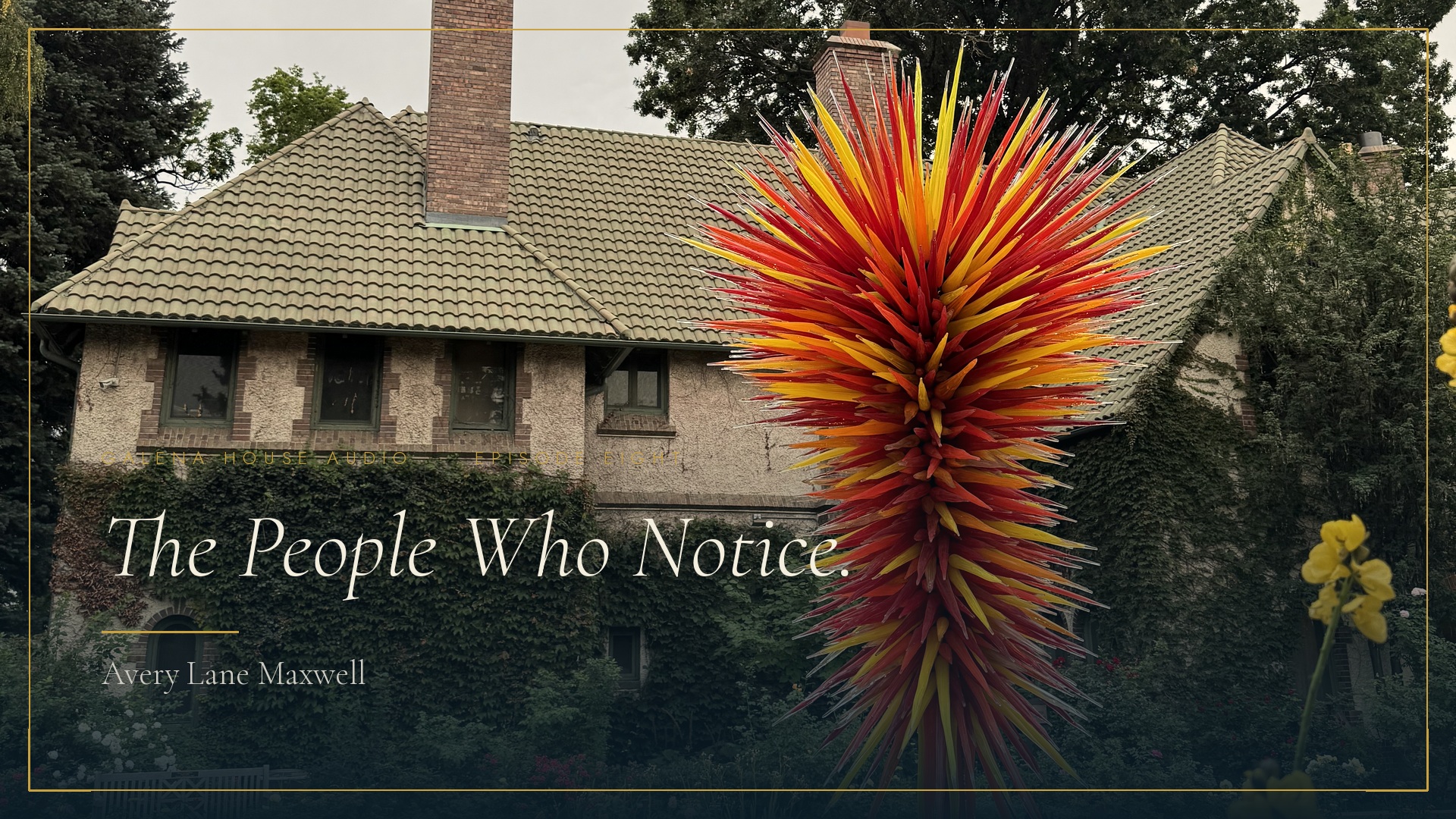
The People Who Notice. Episode Eight of Galena House Audio, from Avery Lane Maxwell.
I have been thinking about the difference between being noticed and being seen. I am very good at the first one. Always have been. I am only now learning what the second one costs, which is nothing, which is the whole problem.
I once wrote a boy who learns very early that people respond well when you make yourself understandable to them. Be pleasant. Be useful. Remember the thing. Know when to speak, and know when not to. Carry your plate to the sink. Notice what nobody else noticed and mention it casually enough that it does not look like noticing.
Very normal childhood hobbies.
The boy gets good at it. Then the man gets very good at it. You can make quite a life that way. People like having you around. Rooms become easier. Someone needs something and, somehow, you are already moving toward it. I know this man. Obviously. I wrote him. What I am only beginning to understand is that there is another experience entirely, and it cannot be arranged. Someone can see you while you are not trying to become visible.
Let me tell you about Thursday, because Thursday was not arranged either. There is a bus that runs from the mountains down to Denver. It is called the Pegasus, which is a lot of name for a bus, and I say that with love. I missed it. Then I missed the next one. I would like to tell you there was a reason. There was not. There was a man who can anticipate the cream before you know you want it, standing at the wrong end of a parking lot with the right coffee.
When I finally sat down in a window seat, the day had already stopped belonging to me, and I think that was the beginning of it. Nine thousand feet let go of me slowly. The aspens were doing the thing they do this week, where the whole hillside seems to have decided something at once. I did not take notes. I want you to hold onto that. I watched, and for once the watching was not for anything.
Denver, then. And the first person I saw when I stepped off was Courtney. My counsel, my publicist, the person who reads the world on my behalf and tells me, gently, where I am standing in it. We have sat across tables before. It does not get less remarkable. There is something that happens when you sit down with someone who has already decided you are worth the trouble. You stop performing your worth. There is no point. She did the reading a long time ago. She did not take on a project. She took on me. I am still not entirely sure what to do with that, except to say thank you, and try to keep being the person she said yes to.
That is the whole of it, really, and I did not know it yet at lunch. The people who matter to me lately are the ones who met me before the introduction. Before the biography. Before I had prepared the room. And who kept coming back after they had seen the rest.
David and Julie met me that way. I do not want to tell you where. The geography is not important, and they would say the same. It was one of the places where my ordinary life happens. I was working. Moving. Talking. Carrying things. Probably thinking about six things at once and finishing four of them. There would have been coffee somewhere. There is usually coffee somewhere. And I was not introducing Avery Lane Maxwell. There was no author bio. No explanation of Galena House. No carefully arranged version of who I am. I was just doing the day.
And they watched. Not in a strange way. That would be a different episode. They simply noticed. The way I moved through people. The way I spoke. The things I cared about. The fact that if somebody looked uncertain, I was probably already trying to make the uncertainty smaller. They saw me while my attention was pointed somewhere else. And I think that matters. Because the person you meet when he is introducing himself and the person you meet while he is busy living can be slightly different people. The second one is harder to arrange. The second one is the only one worth finding.
I used to have a line for what I wanted my work to be. Found, not marketed. I retired it for a while because it started to sound like a strategy, and the moment a true thing becomes a strategy it stops being true. But that is what happened. Nobody marketed me to David and Julie. They found me, in the middle of a Tuesday, doing the ordinary work of being alive, and they decided that was enough to come back for.
That boy knew all about arrangement. He discovered something very young. If the outside of you says the right thing, the world becomes easier. People relax. Teachers smile. Mothers say you are welcome anytime. Employers move you out front. Rooms make space.
And none of that is fake. That distinction matters enormously to me. The warmth was real. The helpfulness was real. The attention was real. The mistake was thinking that because something was constructed, it could not also be sincere. I do not believe that anymore. I think we all build ourselves. We just use different materials. Mine happened to include very good manners and a strange amount of coffee.
Some people get leather jackets. I learned how to anticipate cream. We work with what we have.
But there is a cost to being very good at making yourself readable. Eventually, you start wondering whether people like you or whether they like the version you made easy to like. That is an uncomfortable question. I ask it more often than I would like, usually while I am trying to do something else. Good questions are rude that way.
And then every so often, life answers one without being asked. David and Julie did not meet me after a speech. They met me in motion. And then we talked. Really talked. Books. Paper. Making things. Beauty. The unnecessary detail that becomes necessary once you care about it. Why some objects feel different when another person's hands have been involved. Why a thing should be beautiful even when beautiful is technically more trouble.
I understood them quickly. Not completely. I am trying to stop doing that to people. But quickly enough to recognize something. Oh. You care about this too. That sentence has opened more doors in my adult life than I expected. You care about this too. Not, you can do something for me. Not, I can do something for you. Just: there is a small part of the world both of us refuse to treat casually. Come look.
David and Julie own a stationery shop in Denver called Idea Chic. There is a mailbox out front that says Send More Mail, which is the whole of my philosophy on a sign. And in the back room lives Hazel. Hazel was born in 1933. She is a letterpress. She is enormous. Black iron, wood, belts, gears, a great wheel, all of it gloriously unconcerned with becoming sleek. I had been thinking about Hazel since David first described her to me. A machine nearly a century old that still makes an impression on paper. I mean. Come on. You cannot tell a writer that and expect him to behave normally. I took two buses. Obviously.
And there they were. David. Julie. Hazel. The three of them already inside a relationship I was only beginning to understand. David knows the machine. You can see it in his hands. There is a particular way people move around something they truly know. No wasted motion. No theatrical competence. The hand goes where it belongs because it has gone there before. Julie knows the other side of the object. Paper. Color. What someone will eventually hold. The little decision that makes a card become the card. And Hazel knows pressure. Hazel is very good at pressure.
I watched the wheel move. I watched ink spread. I watched old wooden forms come apart in the hand. I watched orange become pumpkin. And I took photographs of absolutely everything, because apparently when I am delighted I become a small investigative agency.
There was one moment when David showed me the old wood. Pieces darkened by ink and years. Individual blocks that, by themselves, did not say much of anything. Put them together correctly and suddenly there was language. That stayed with me. Of course it did. People are like that. Lives are like that. A coffee cup. A boy on a bicycle on a red dirt road in Georgia. A recipe. A song. A room. A person you knew for three months. A person you have known for thirty years. A sentence somebody said once and forgot entirely. Individually, they are pieces. Then one day you look at the whole arrangement and realize: oh. That spells me.
I have spent a lot of time trying to understand who Avery Lane Maxwell is. This may surprise nobody listening. I have written about him under other names. I have written about the other names. I have built an entire little house around the investigation. There are easier hobbies.
But something has changed lately. I am becoming less interested in defining myself before I live. I would rather go find out. That is new. For years, observation came first. Life happened. I stepped slightly outside it. I studied the event. Then I understood how I felt. Sometimes Wednesday understood Tuesday. Occasionally a whole book understood a year I had already lost.
There is a line of machinery in me that I recognize almost embarrassingly well. The watcher. The part of me standing one step behind the person having the experience, taking notes. He is extremely competent. I am fond of him. He kept excellent records. But lately he has been missing things. Not because he has gotten worse at watching. Because I keep getting there first.
I smile before I inspect the smile. I laugh before I decide why something was funny. I like somebody before I have finished learning them. I go somewhere because a friend said, you should go. And then I am simply there.
That last one happened after Idea Chic. David and Julie told me to spend the evening at the Denver Botanic Gardens. I had time before the bus home. Normally, time is extremely vulnerable around me. Give me three empty hours and I will find six jobs for them. A website. A manuscript. An email. Something that needs adjusting by three pixels for reasons nobody else on earth will ever know. There are entire civilizations that have collapsed under less management.
But they said, go to the gardens. So I went to the gardens.
And I found a new happy place. I mean that plainly. I walked in and something in me knew almost immediately that I would come back. There was water. Stone. Trees. Paths that bent just enough that you could not see where they finished. Little changes in height. Little rooms made without walls. Denver moving somewhere beyond all of it, still being Denver, while inside the garden people became quieter without anyone asking them to. I love when a place does that. Not commands quiet. Earns it.
I walked. That was all. No task. No one waiting for me to improve anything. No one asking what I thought. Nothing needed to be ready by morning. The garden had been doing perfectly well before I arrived. That is healthy for me.
I watched the light change. Sat for a while. Got up. Found another path. I remember thinking that if I had known the place existed, I probably would have planned it. Scheduled it. Made the right amount of time. Looked up what I was supposed to see. There would have been efficiency. I am very capable of ruining wonder with excellent planning. It is one of my gifts.
Instead, I had been sent there. By new friends. That made the whole evening feel borrowed in the best way. Like I had been handed a few hours from somebody else's knowledge of the city. Here. We think you would like this. Go. And I did. That is connection too. I think I have spent so much time writing about the emotional architecture of people that I occasionally forget the very ordinary ways we alter one another. A recommendation. A book. A restaurant. Take this road. Listen to this song. You would love her. Order this. Go there before sunset. One person nudges another person's life three degrees to the left. And three hours later he is standing beside a pond in Denver thinking: I am happy.
I keep coming back to that. Not because happiness is rare. I do not think it is. I think we are often moving too quickly through it to catch it in the act. That is different. I once wrote a man who can explain a room perfectly and sometimes cannot quite occupy his own chair. He can tell you what everybody needs. He can make himself necessary. He can build warmth so convincingly that everybody else feels it. And then he stands at the edge of the thing he built and asks whether it reached them.
I love that man. I am not interested in humiliating him now that I understand him. He got me here. But this is where the story changes. I am in the room too.
David and Julie did not simply receive something I made for them. They gave something back. Their work. Their enthusiasm. Hazel. Their city. A garden. The suggestion of another afternoon. Friendship. And I let it come toward me. That sounds small. For me, it is not.
There is another moment I keep thinking about, from a year I wrote down as it happened. A new friend appears. Unexpectedly. And in the private handwriting from that year, I wrote how happy I was to have found him. There was no pressure to the conversation. It felt safe. Later, I wrote that perhaps the friendship was simply organic. Building. Maybe good for him. Maybe good for both of us. Even in my own journal I turned myself into a case study.
Absolutely exhausting man.
But look at the word I chose. Organic. I think I knew something before I knew I knew it. The relationships I trust most are not always the ones I constructed beautifully. Some of them just grew. No architecture first. No projection. No useful role I had to fill before I earned the chair. Two people met. Something was easy. They came back.
I have some new friends. David and Julie. I like saying their names. I like that the friendship did not arrive with a job description. I like that we share a fascination with beautiful things and the hands that make them. I like that they introduced me to Hazel. I like that they looked at the remaining hours of my Denver day and thought there was somewhere beautiful I should see. And I like that they were right.
That is what friendship does at its best. It does not merely know you. It adds territory. Your map gets larger. Here is a shop where you know two people now. Here is a machine with a name. Here is a garden you did not have yesterday. Here is a photograph that did not exist last week. Here is a future afternoon already possible because somebody entered the present one.
I have moved a lot in my life. I started on a road in Georgia that most maps do not bother with, and I have been looking for the next room ever since. Places have meant too much to me before. I know that. I know what it is to arrive somewhere and immediately begin asking it to explain who I am. This town will fix it. This room will make sense of it. This job. This person. This version. I do not ask places for that anymore. That may be why I can love them better. The Botanic Gardens do not have to save me. Denver does not have to become destiny. David and Julie do not have to become characters in some future architecture I have already designed for them. They can be David and Julie. New friends. Hazel can be Hazel. A magnificent machine. The garden can be somewhere I go because I am happy there.
That is enough. More than enough, actually. There is an enormous freedom in allowing beautiful things to remain their actual size. I used to believe making something meaningful required making it large. Now I think attention does the opposite. Attention lets a small thing remain small without becoming insignificant.
A pumpkin printed in orange ink. A recommendation made in passing. A few hours before a bus. A photograph of three people standing beside an old press. None of those things needs enlargement. They already happened. They already reached me.
The brand people would probably tell me I should not say this next part. Which is precisely why I am going to. Avery Lane Maxwell is not a character I put on in the morning. He is also not some pristine authentic self hidden underneath everything I have built. That is too simple. I made him. And then I became him. Or perhaps I became him by making all the things he would make. The music. The rooms. The ridiculous attention to paper. The insistence that one sentence can still be better. The coffee. The photographs. The letters. Galena House. All of it. Construction is not the opposite of sincerity. Sometimes construction is how sincerity acquires walls.
But the test, I think, is what happens when nobody has been told to look. Do they still see you? David and Julie did. Courtney does, every time, and has for a while now. That is what moved me. They met me before the biography. They watched me going through an ordinary day and found something there worth knowing again. There is no award I could get for my work that would replace the particular pleasure of that. Because somewhere underneath all the ambition, there is still a boy who learned very early how to become welcome anywhere. And the question he could never quite answer was whether anyone would have welcomed the person who had not prepared the room first.
I think I know now. Some people do.
The sun was lowering when I was at the gardens. I remember that more than any particular plant. Light moving across water. The day losing its edges. People beginning to leave. That peculiar hour when you become aware that a beautiful place will continue existing after you walk out of it. I used to find that sad. Now I find it comforting. I do not have to keep everything alive. I can leave. I can come back. The garden will be there. My friends will have their lives. I will have mine. Somewhere Hazel will keep turning that enormous wheel. The world does not require my supervision in order to remain beautiful.
I cannot tell you how relaxing this information is.
And maybe that is the sentence I have been writing toward for eight episodes. Not, I finally found the right place. Not, I finally became the right person. Not even, I finally learned how to stay. Something simpler. I am becoming available to my own life.
I am there when somebody interesting walks into it. I am there when friendship begins. I am there when an old machine presses orange into paper. I am there when somebody says go to the gardens and, instead of finding a reason not to, I go. I am there when the water catches the evening light. I am there when I realize I want to come back. I am there when the bus pulls out of Union Station and the city goes gold behind it and I do not reach for my notebook.
And increasingly, I do not need to stand one step behind myself and take notes first. Sometimes Avery gets to go. The writer can catch up later.
He always does.
I spent years becoming someone other people could read. Maybe this part of my life is about becoming someone I can simply live as. That person still notices everything. He still makes too much coffee. He still misses the bus. He will still adjust something by a quarter inch when nobody else can see the difference. He will probably always make a room easier if he knows how. I like those things about him. I am keeping them. But there is more room now. For surprise. For receiving. For other people's ideas. For a new road through a city. For friends I did not plan on having. For places I did not know I needed. For delight that does not need to become evidence before I trust it.
I have been looking for home for as long as I can remember. I used to think it was a place. I have asked a great many places. Then I thought it was a version of me I had not finished building yet, and I built, and I built, and the lights never quite came on. I think now it is simpler and stranger than either. Home is not a place. Home is a person. It is the one who saw you before you started and came back anyway. Sometimes that person is a friend who says go to the gardens. Sometimes it is a woman who did the reading. And sometimes, if you are patient with yourself, that person is you. I am home. Not the walls. Me. And if you are listening to this in a car or a kitchen or the last hour of a shift, you are somebody's home too, whether or not anyone has told you yet. Found. Not marketed. It always was. Some things know the way back.
I have some new friends. Pretty cool. And because of them, I have a new happy place too. That is not a grand revelation. It is better. It is Thursday ordinary. Real enough to photograph. Small enough to keep.
Courtney. David. Julie. Hazel. The gardens. A bus I nearly missed twice. A day in Denver. Avery, somewhere in the middle of it, having a very good time.
Maybe that is what shining actually is. Not making the room look at you. Being so completely inside your own life that somebody notices the light anyway.
I am Avery Lane Maxwell. This is Galena House Audio. And apparently, the world is still introducing itself. I think I will let it.
Hear it read, in the author's voice · The film · The letters